Embodied AI · Multimodality · 2025
NORA + NORA-1.5
NORA turns an image and an instruction into robot actions; NORA-1.5 learns from comparisons between candidate actions.
NORA on a real robot
NORA is asked to put the blue cube on the plate. This recorded example comes from the original project demonstrations.
All NORA trials ↗Turning an instruction into movement
A vision-language-action policy must locate the right object, understand a verbal goal and emit low-level motion commands quickly enough to control a robot. The hard cases are not only new objects. Distractors, spatial language, long action sequences and a change of robot embodiment can each break the mapping from pixels to movement.
NORA: a 3B autoregressive robot policy
NORA starts from Qwen2.5-VL-3B and trains on 970,000 real-robot demonstrations from Open X-Embodiment. It receives one 224 × 224 third-person image and a language instruction. FAST+ applies a discrete cosine transform and byte-pair encoding to continuous robot actions; NORA adds 2,048 action tokens to the model vocabulary and predicts them autoregressively. The base model replans after one action, while NORA-Long predicts a five-action horizon.
The paper reports about 8.3 GB of GPU memory at inference. Pretraining was still substantial: 1.1 million updates over roughly three weeks on eight H100 GPUs, or about 4,000 H100-hours.
What NORA was tested on
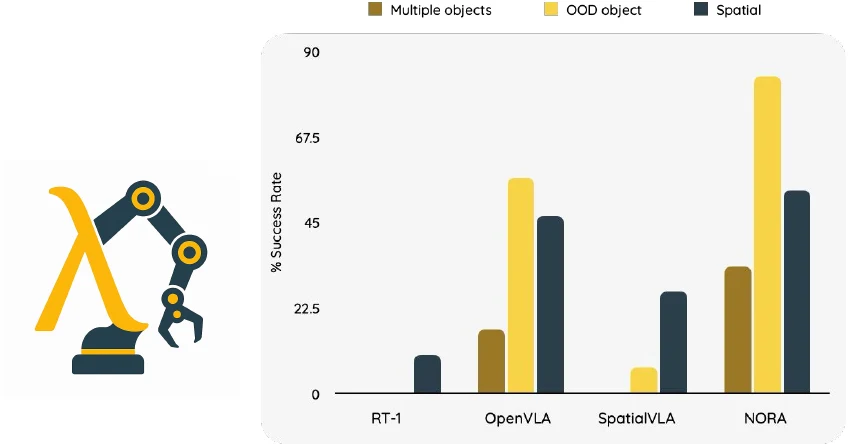
The real-robot study ran nine WidowX-250 tasks ten times each. The tasks covered unseen objects, spatial instructions and placing two objects. NORA averaged 56.7% success, compared with 40.0% for OpenVLA, 11.1% for SpatialVLA and 4.4% for RT-1. Its success was 90% for both “put carrot in pot” and “put banana in pot,” but only 30–40% on the three multi-object tasks.
On LIBERO, the paper evaluated the Spatial, Object, Goal and Long suites over 500 trials. Fine-tuned one-step NORA averaged 73.9%; using five-action chunks at fine-tuning raised this to 79.5%. NORA-Long, pretrained and fine-tuned with a five-action horizon, reached 87.9%, compared with 76.5% for fine-tuned OpenVLA and 78.1% for SpatialVLA.
The same chunking strategy did not transfer cleanly to the lower-frequency WidowX setup. Executing all five predicted actions without replanning caused collisions. Executing only the first action avoided them, but NORA-Long then scored 0% on the tested two-object task and 40% on “move the banana close to the pan.” Added distractor objects also reduced both NORA and OpenVLA performance.
NORA-1.5 keeps two ways to generate actions
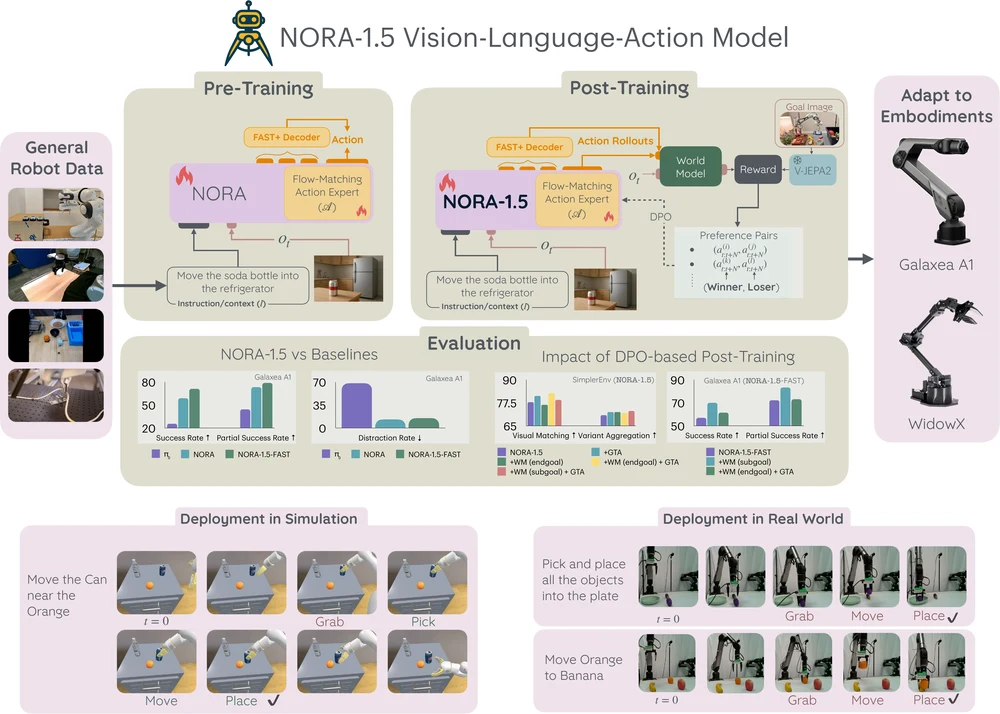
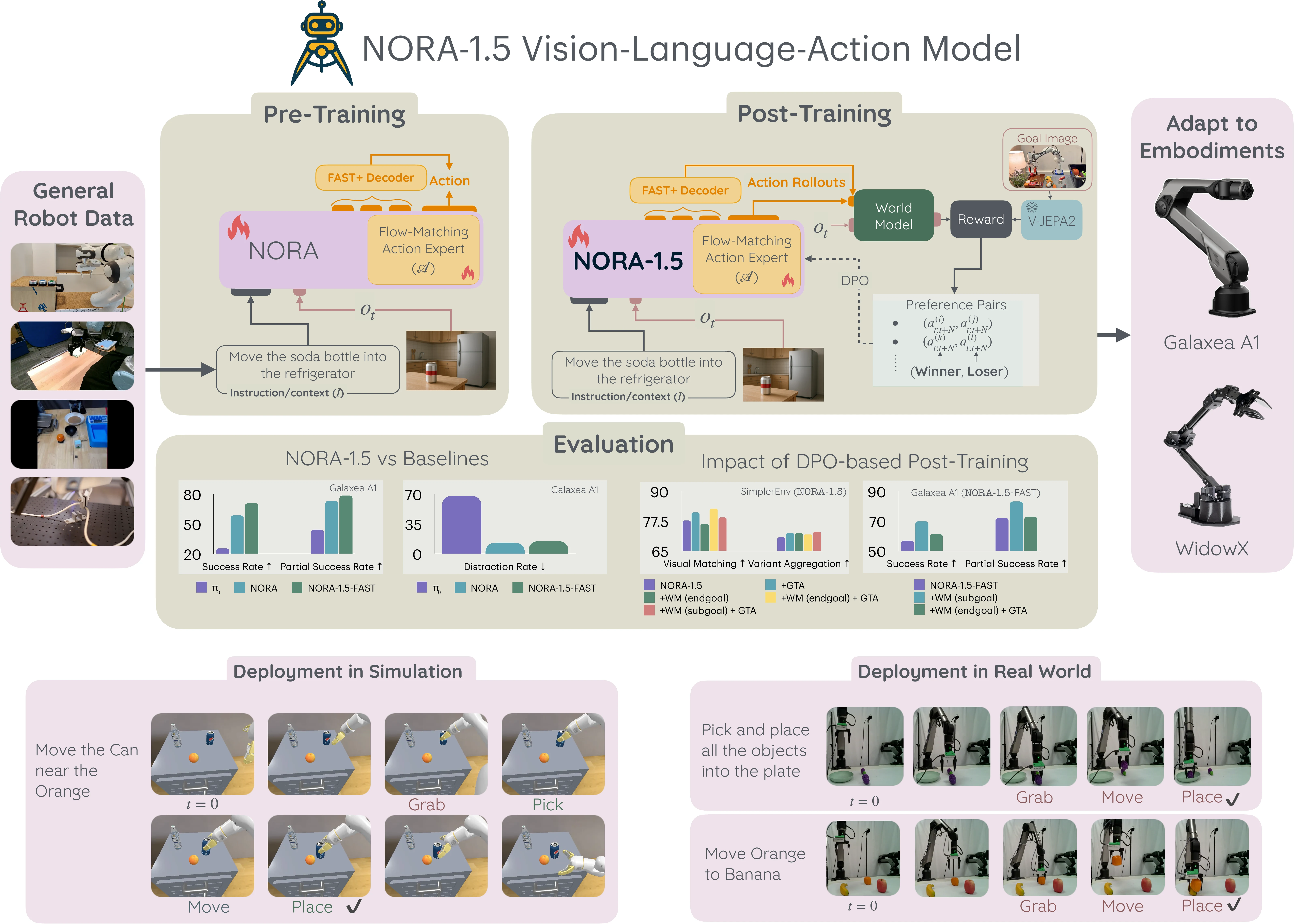
NORA-1.5 extends NORA-Long with a roughly 400M-parameter flow-matching expert that reads intermediate keys and values from the vision-language backbone and generates five continuous actions. It does not discard the FAST+ decoder. Training jointly optimizes cross-entropy over FAST+ tokens and flow-matching loss, so the same model can be evaluated through the autoregressive -FAST branch or the continuous expert. The expert and backbone were jointly trained for another 150,000 updates on the same Open X-Embodiment mixture, using about 960 H100-hours.
Turn predicted outcomes into preferences
After supervised fine-tuning on a target robot, NORA-1.5 samples several candidate action chunks for the same image and instruction. A 1.3B V-JEPA2 action-conditioned world model predicts the next visual embedding; distance to an end-goal or immediate subgoal image becomes one reward. A second reward is the L1 distance from the recorded action. The combined score gives the action-distance term half the weight of the visual goal term, ranks candidates into winner-loser pairs, and Direct Preference Optimisation updates the policy from those pairs.
What changed after post-training
On SimplerEnv visual matching, fine-tuned NORA-1.5 averaged 77.9% success before preference training and 82.8% after DPO with the end-goal-plus-action reward. Under variant aggregation, the same comparison was 70.7% to 71.9%. On LIBERO, NORA-1.5 averaged 94.5% before DPO and 95.0% after it; the Object suite moved in the other direction, from 96.4% to 96.0%.
For cross-embodiment transfer, the team collected 1,000 teleoperated episodes on a Galaxea A1 arm, a robot absent from pretraining. Across nine tasks with ten trials each, the FAST branch of NORA-1.5 reached 71.11% full success, compared with 58.88% for NORA and 25.55% for π₀. On an expanded 13-task set with more distractors, subgoal-plus-action DPO raised full success from 56.92% to 70.00%, partial success from 72.30% to 83.84%, and reduced distractor grasps from 16% to 12%.
Why the reward still needs checking
The Galaxea results show why keeping both action decoders matters: on its smaller 50,000-frame adaptation set, the FAST branch outperformed the flow expert, reversing their ordering in the larger simulation settings. The reward also has to be interpreted in terms of what it measures. A world model may predict the wrong outcome, while distance from a recorded action may penalise a different movement that would still succeed. These issues help explain why preference training needs task-level checks—the gains on the already saturated LIBERO suites were small and uneven, and a better-ranked action still has to be tested on the robot.