
Introduction
Most ideation systems optimize one proposal at a time. This can produce a high-scoring idea while the full set remains repetitive. IDEAgent instead treats ideation as a quality-diversity search problem: under a fixed budget, it tries to increase the number of ideas that clear stated quality thresholds and remain distinct from those already accepted.
How IDEAgent works
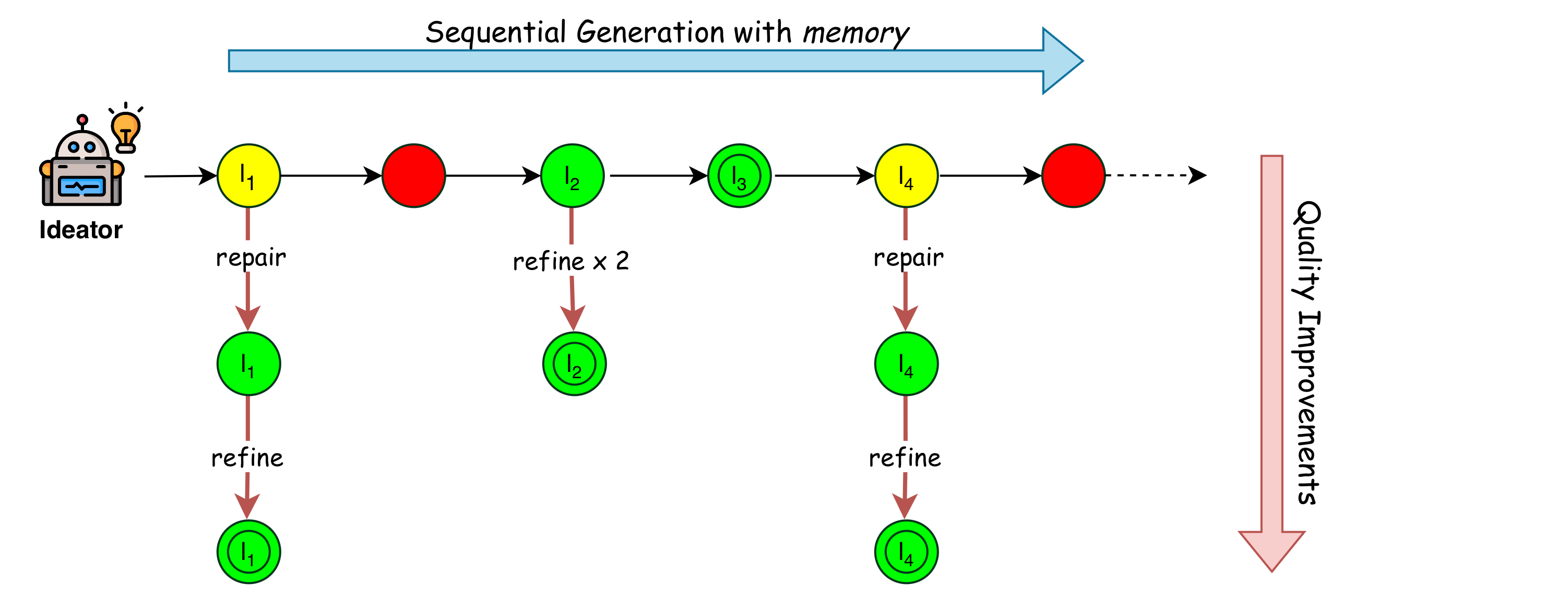
The system has four main pieces:
- Generate ideas sequentially, using the context of prior ideas to explicitly avoid repetition and encourage diversification.
- Decompose each free-form idea into specific fields, providing a more interpretable representation for pairwise comparison between ideas.
- Treat improvements to an idea as children of a common parent and assign them the same lineage identifier, so they are not mistakenly counted as separate “new discoveries.”
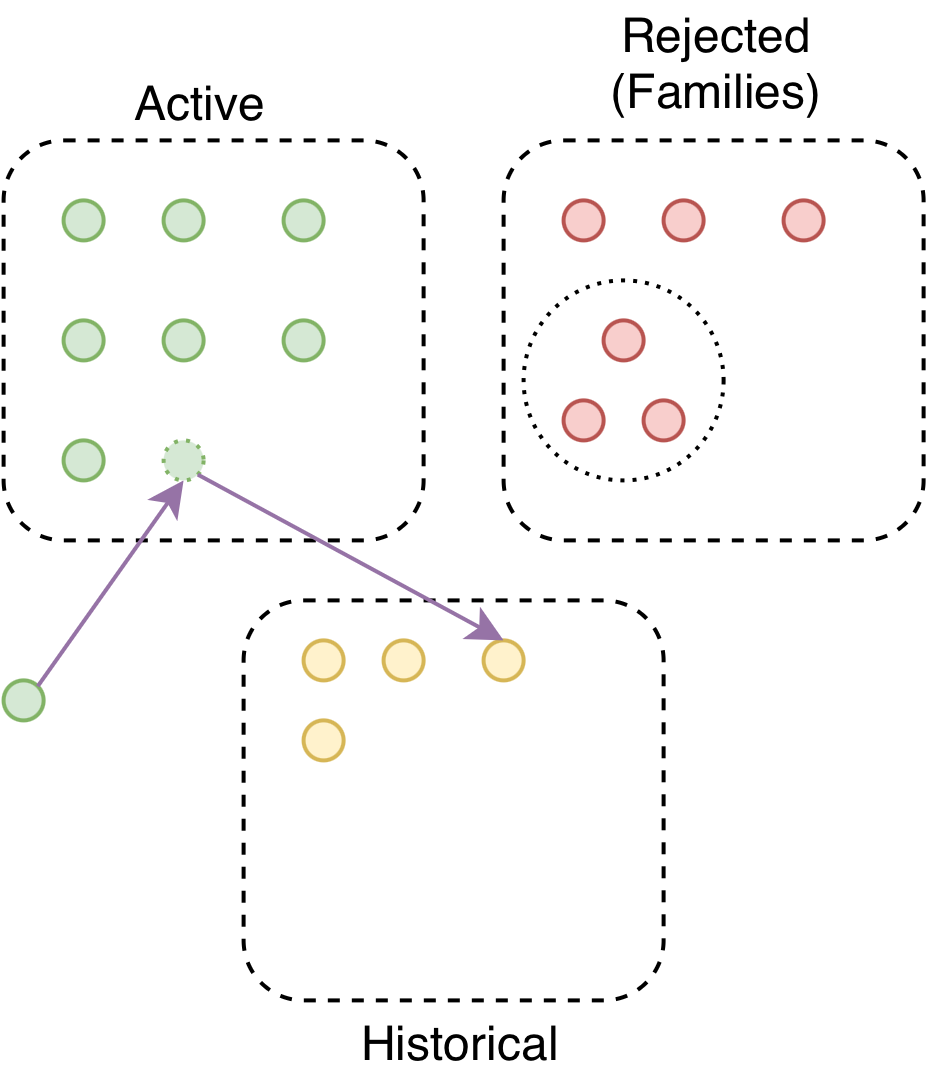
- Maintain archives of currently accepted ideas, historical/retired ideas (superseded by newer versions), and rejected ideas and families. Rejected ideas are clustered into families to capture broader avoidance patterns and help identify similar ideas in the future.
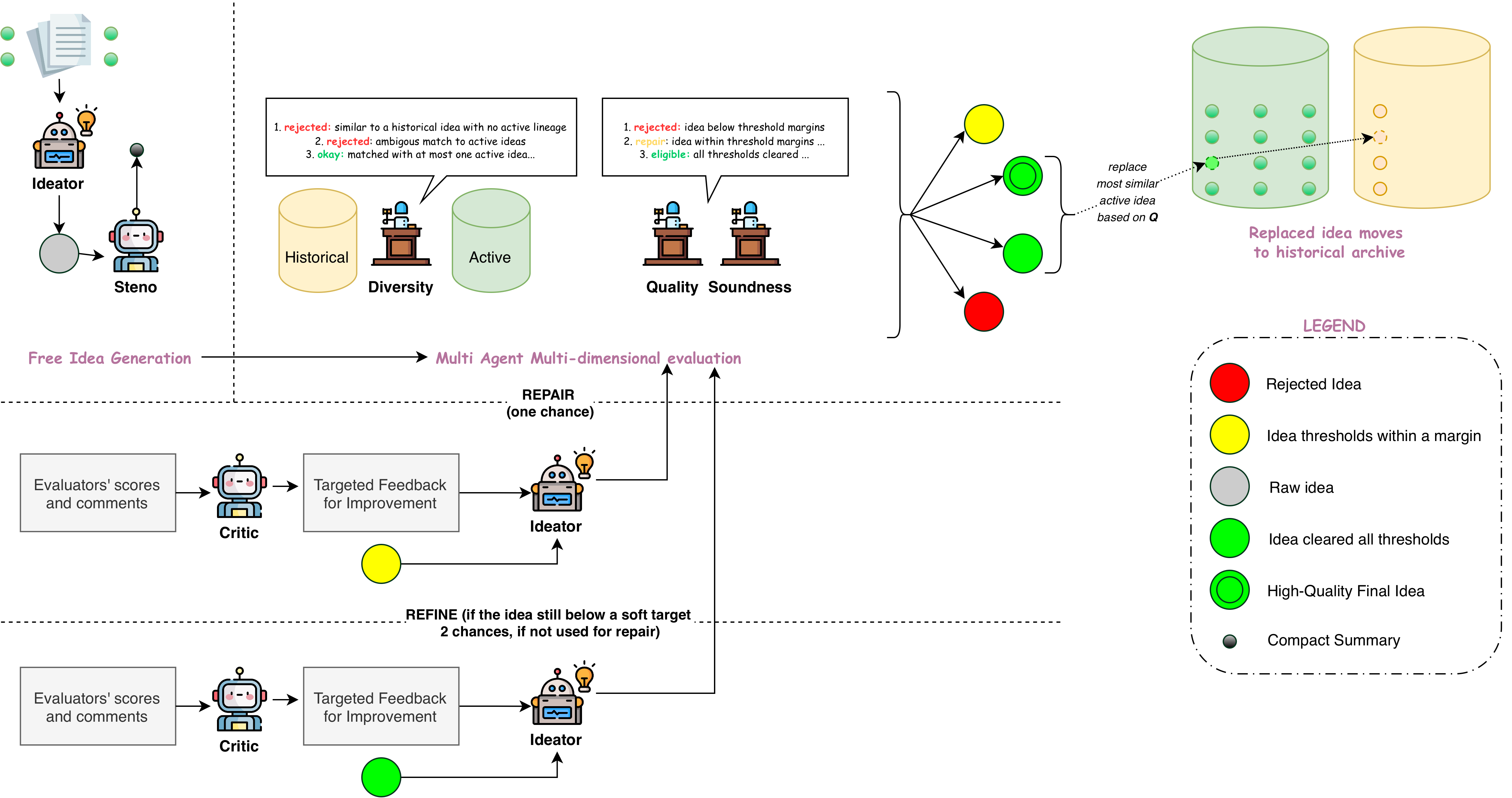
Six LLM agents handle generation, summarisation and evaluation:
- Ideator: The primary generator that produces new ideas or refines existing ones.
- Stenographe: Compresses each idea into a structured representation by identifying the problem addressed, central mechanism, novel addition over the background literature, key assumptions, and expected measurable effect from the prose.
- Quality Judge: Grades the idea ($I$) on Non-obviousness ($N_I$), Clarity ($C_I$), and Feasibility ($F_I$) on a scale of 0–100.
- Soundness Panel: Assesses the logical and mathematical rigor of the idea and its assumptions using five independent judgments for broader coverage. The judgments are given on a scale of 0–9 and then aggregated into a single score on a 0–100 scale ($S_I$).
- Diversity Judge: Compares the idea against all archives and identifies the nearest duplicates from each. It also assigns a single score ($D_I$) on a 0–100 scale to capture the overall uniqueness, novelty, and diversity of the current idea with respect to prior generations.
- Critic: Assimilates the judgments and scores from the three aforementioned judges to produce a single, targeted improvement directive for the Ideator, guiding it to improve the current generation.
We define the overall quality score as: $Q = 0.7N_I + 0.2S_I + 0.1C_I$, with ties decided by $F_I$.
Search procedure
- An idea generated by the Ideator is first compressed by the Steno into a structured summary, which is used for future comparisons.
- The full idea is then scored by all three judges. The Diversity Judge also produces a list of near-duplicates from each archive.
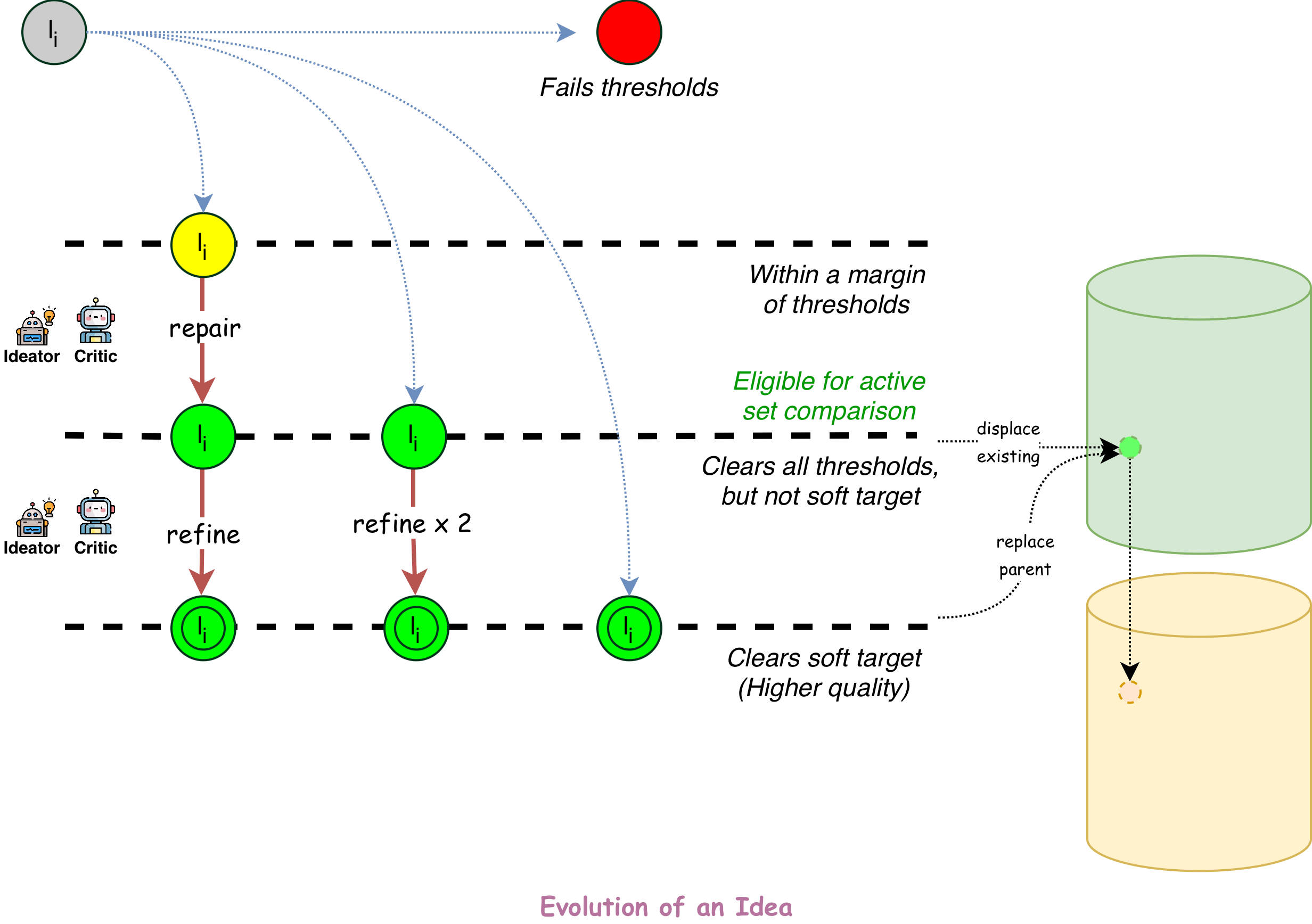
- If the idea fails to clear the required threshold for any metric (Non-obviousness, Clarity, Soundness, or Diversity) by more than a permissible margin, it is rejected and added to the rejected archive. It is also assigned to one or more rejection families based on its failure pattern.
- If the idea matches an idea in the historical archive but has no match in the active set, it is discarded because it has replicated an older idea that has already been superseded.
- If the idea falls below a threshold but remains within the permissible margin, it gets an opportunity for repair. Based on the Critic’s feedback, which incorporates the evaluation results, the Ideator corrects the bottleneck or problematic aspects of the idea. The repaired idea is then evaluated again. If it still fails to cross the required thresholds, it is rejected.
- If the idea, either before or after repair, clears all the thresholds, it becomes eligible for acceptance. If the active set (which has a fixed capacity) is not full, the idea is added directly. If the active set is full, the incoming idea competes against its closest match in the active set, as identified by the Diversity Judge. The idea with the higher overall (Q) score is retained, while the other is moved to the historical archive. If the incumbent is replaced, the newcomer inherits its lineage because it was identified as a duplicate of the incumbent, thereby preserving the lineage.
- Once an idea is accepted into the active set, it has up to two additional refinement opportunities, provided that one of them was not already used for repair. Refinement is triggered when the idea falls below a higher soft target above the acceptance thresholds. The Critic’s feedback is again provided to the Ideator, and the resulting variant is accepted if it preserves Non-obviousness while improving the overall quality score. If the refinement does not meet these criteria, the new child is discarded.
- Once the search budget is exhausted, the ideas remaining in the active set are treated as the final variants and passed on for downstream evaluation.
Evaluation
We evaluate our ideas at both the individual and group levels using LLM-based judges that are distinct from those used during generation (i.e., the internal evaluation).
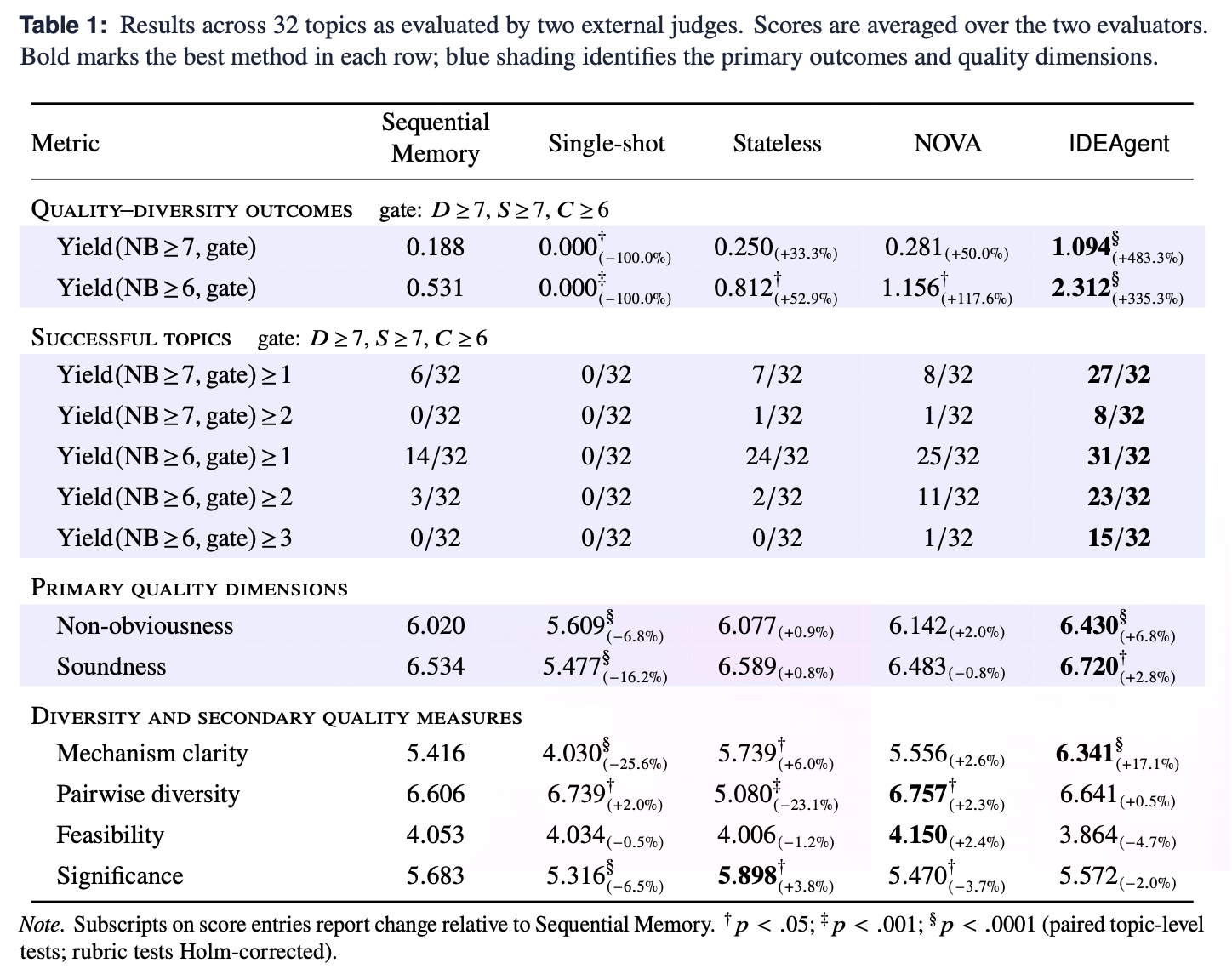
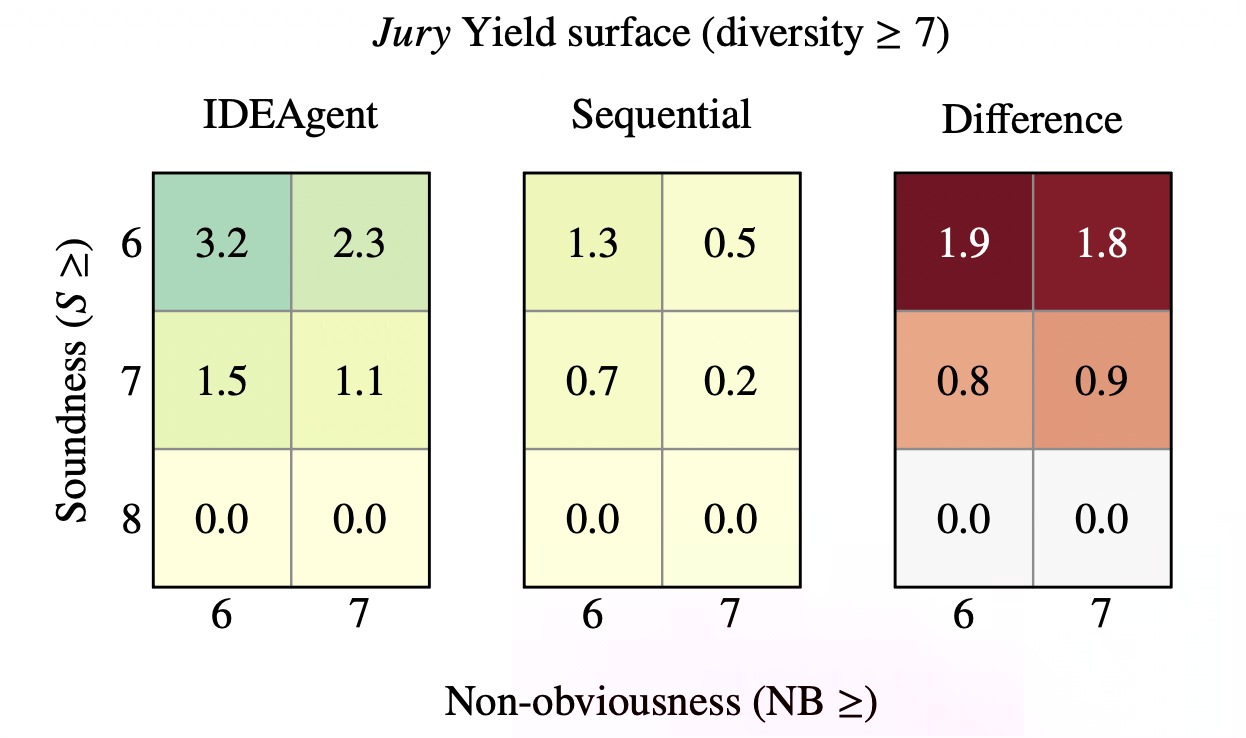
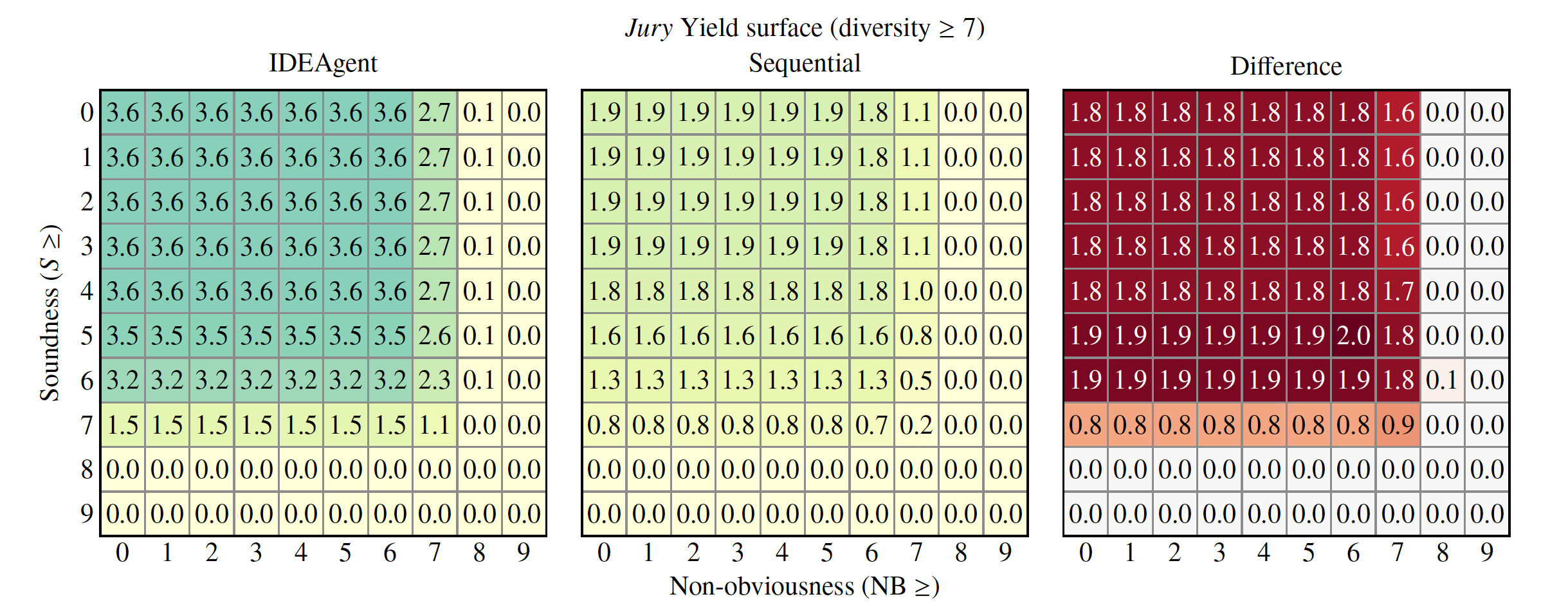
At the individual level, we evaluate each idea for Non-obviousness, Soundness, and Clarity as our primary quality metrics, each on a 0–9 scale. At the group level, we compute Diversity pairwise between ideas, also on a 0–9 scale. Finally, Yield filters ideas through predefined quality gates and measures the largest subset that also satisfies a pairwise diversity threshold.
Results
We compare IDEAgent with four alternatives and ablations:
- Stateless: Naive parallel generation of N ideas, with no information shared between them.
- Single-Shot: Generates all N ideas at once in a single output. For a thinking-based Ideator, the reasoning space is shared across all N ideas, allowing them to share a common memory block for reference and diversification.
- Sequential Memory: Sequentially generates ideas while providing summaries of prior generations as references for diversification. In other words, this is IDEAgent without the quality-improvement component.
- NOVA: A NOVA-inspired version of Sequential Memory that uses iterative seed-pool-based germination and replacement for diversification. In each round, N ideas are generated, after which an internal judge selects the K most promising ideas as seeds for generating the next N ideas. After three rounds, the internal judge selects the most diverse N ideas from the resulting 3N ideas.
Limits and next steps
IDEAgent evaluates ideation at the level of a set, not only one proposal at a time. Yield makes the quality and diversity thresholds explicit. Both the search and the evaluation depend on model-based judges, so the results do not show that the generated proposals are scientifically correct or useful. Expert review, literature checks and experiments are still required.
Citation
@misc{gumma2026ideagentagenticqualitydiversitysearch,
      title={IDEAgent: Agentic Quality-Diversity Search for Research Idea Generation},
      author={Varun Gumma and Navonil Majumder and Soumitra Sinhahajari and Soujanya Poria},
      year={2026},
      eprint={2607.22375},
      archivePrefix={arXiv},
      primaryClass={cs.AI},
      url={https://arxiv.org/abs/2607.22375},
}