Evidence acquisition
- Directed search chooses what to investigate.
- Active perception makes hidden evidence visible.
Benchmark
RoboQuest places a mobile manipulator in unfamiliar kitchens. The goal is given; task-critical information must be physically acquired.
01 · Search · Simulation
Open storage places, track what has been checked, and retrieve the complete target set.
02 · Inspect · Simulation
Turn objects to reveal unseen faces before deciding which bin they belong in.
03 · Test · Simulation
Make trial impressions to discover patterns and rotations before committing permanent marks.
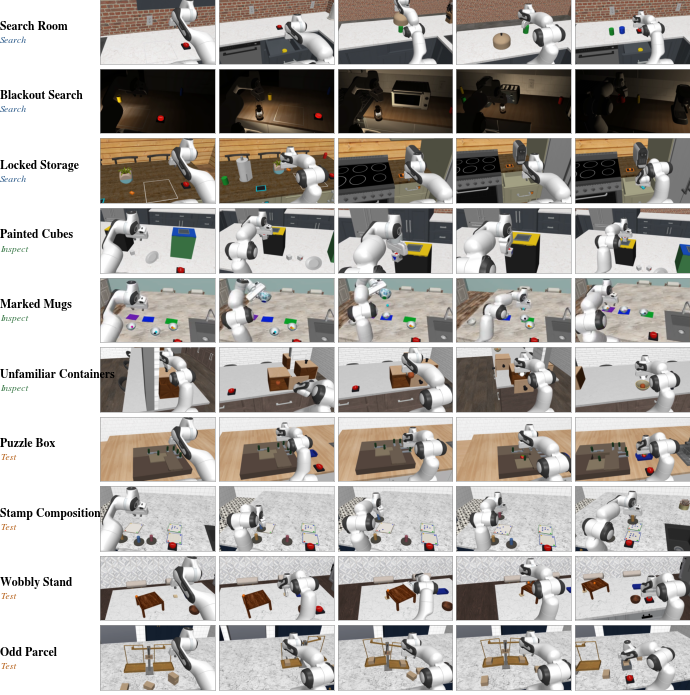
Selected demonstrations with all three camera views: left scene camera, right scene camera and wrist camera. Aggregate results are reported separately.
A physical button press commits the result and freezes the score. Every goal condition must hold. Stopping without pressing it is a failure.
Tasks
A set of target items is stored in open or closed locations around a room, among distractor items of similar kind. The goal is to collect the complete set on the tray and press SUBMIT. The locations, the number of storage places, and which storage places are empty are not given. The robot must choose where to search, use negative findings to redirect, remember what it has checked, and stop once the set is complete. Instances vary the set size, item category, room layout, number and type of storage units, and distractors.
Storage compartments open only when a matching access token rests on their reader. Tokens are either outside the initial observation or hidden inside other storage, and some compartments contain tokens for other compartments, forming a dependency chain. The goal is to retrieve the target item. Finding a token changes which places can be searched next. Closing a compartment with a token still inside locks that token away permanently, so the robot must plan token handling as well as search order. Instances vary the number of locked compartments, chain structure, token hiding places, and dead ends.
A search task is performed in an unlit room. Only a light source with a glow marker and the SUBMIT button are visible at the start. The robot must acquire the light source, carry it, and search using a wrist camera that sees only what is illuminated. Because one gripper holds the light, retrieving a target requires putting the light down while aiming it at the target, then acting from memory in the dark. Instances vary the target, room, location of the light source, whether a wall switch exists, and whether a timed light turns off after a delay.
Several identical vessels, all mugs or all bowls in a given instance, each hold loose contents, and a label on the underside of each vessel specifies its destination. The goal is to place every vessel upright at its destination with its original contents inside. Reading a label requires lifting or tilting the vessel, which spills the contents; spilled contents stay nearby and must be returned to the correct vessel before submission. Instances vary the number of vessels, contents, label-to-destination mapping, and initial poses.
A collection of similar objects each carries a hidden property distributed over its faces, such as the number of painted faces, with some faces turned toward the table or away from every camera. The goal is to collect every object satisfying a stated property, for example, exactly one painted face. Partial views can reject an object but cannot confirm it, so the robot must decide how much inspection each object needs. Instances vary the number of objects, property rule, initial orientations, and whether the goal asks for one qualifying object or all of them.
Several closed containers each open by a different mechanism, such as a hinged lid, sliding lid, drawer, or latched flip-top, and some cannot be opened at all. The target is inside one of them. The robot knows neither where the target is nor how each container opens and must discover each mechanism by interaction. Instances vary the number of containers, mix of mechanisms, target location, and number of decoys.
Several stamps with unmarked housings each carry a hidden pattern and start at an unknown rotation. A target pattern is shown on a reference. A test surface allows trial impressions, and a final surface must end with exactly the target. The robot must test stamps, read the results, select a subset and their rotations, compose the target, and press SUBMIT. Marks on the final surface are permanent. Instances vary the number of stamps, patterns, target, initial rotations, and size of the test surface.
A set of visually identical sealed parcels contains one or two parcels that differ in weight. The only instrument is a two-pan balance whose pans hold several parcels each. The goal is to place the odd parcel alone on the tray. Group weighing identify it in few comparisons, while one-by-one weighing is legal but slower. Instances vary the number of parcels, whether the odd parcel is known to be heavier or could be lighter, pan capacity, and parcel appearance.
A container is held closed by a chain of interlocking parts, where each part blocks another until it is moved. All parts are visible with large handles, but the blocking relations are not. The goal is to place the item inside on the tray. The robot must discover the release order by trying moves and observing what moves, and some wrong moves jam another part until reversed. Instances vary the number of parts, chain structure, presence of red-herring parts, and trap moves.
A stand or table has an uneven support, tilting its surface by an amount too small to see directly. A ball placed on the surface rolls toward the low side and reveals the tilt. Shim blocks of different thicknesses are available. The goal is a level surface on which the ball stays put, with everything released. Instances vary the number of legs affected, tilt magnitude, shim set, and whether the tilt is along one axis or two.
A shared physical world
The capabilities behind the tasks
Ten tasks probe nine capabilities across four groups. The matrix marks direct targets and supporting requirements; success alone does not isolate any one capability.
Directly targetedSupporting requirementNo designated requirement
Capability links describe the task design, not independent causal measurements.
Related benchmarks
Representative manipulation benchmarks target long horizons, hidden information, memory or mobility. RoboQuest targets all of them together with search, inspection and testing.
Feature designations reproduce the manuscript comparison; they describe designated benchmark targets, not the limits of every task in each suite.