IDEAgent: Agentic Quality-Diversity Search for Research Idea Generation
DeCLaRe Lab, Nanyang Technological University, Singapore
Abstract
Large Language Models (LLMs) have significantly advanced the automation of scientific discovery. However, existing
systems share a core limitation: they optimize ideas independently for either Quality or Diversity.
This often results in closely related ideas or large sets of trivial, unsound, or unclear concepts. We instead argue
that research ideation should be framed as a conjunction of Quality and Diversity objectives, i.e., a
Quality-Diversity (QD) search. Accordingly, we introduce IDEAgent, a multi-agent framework that
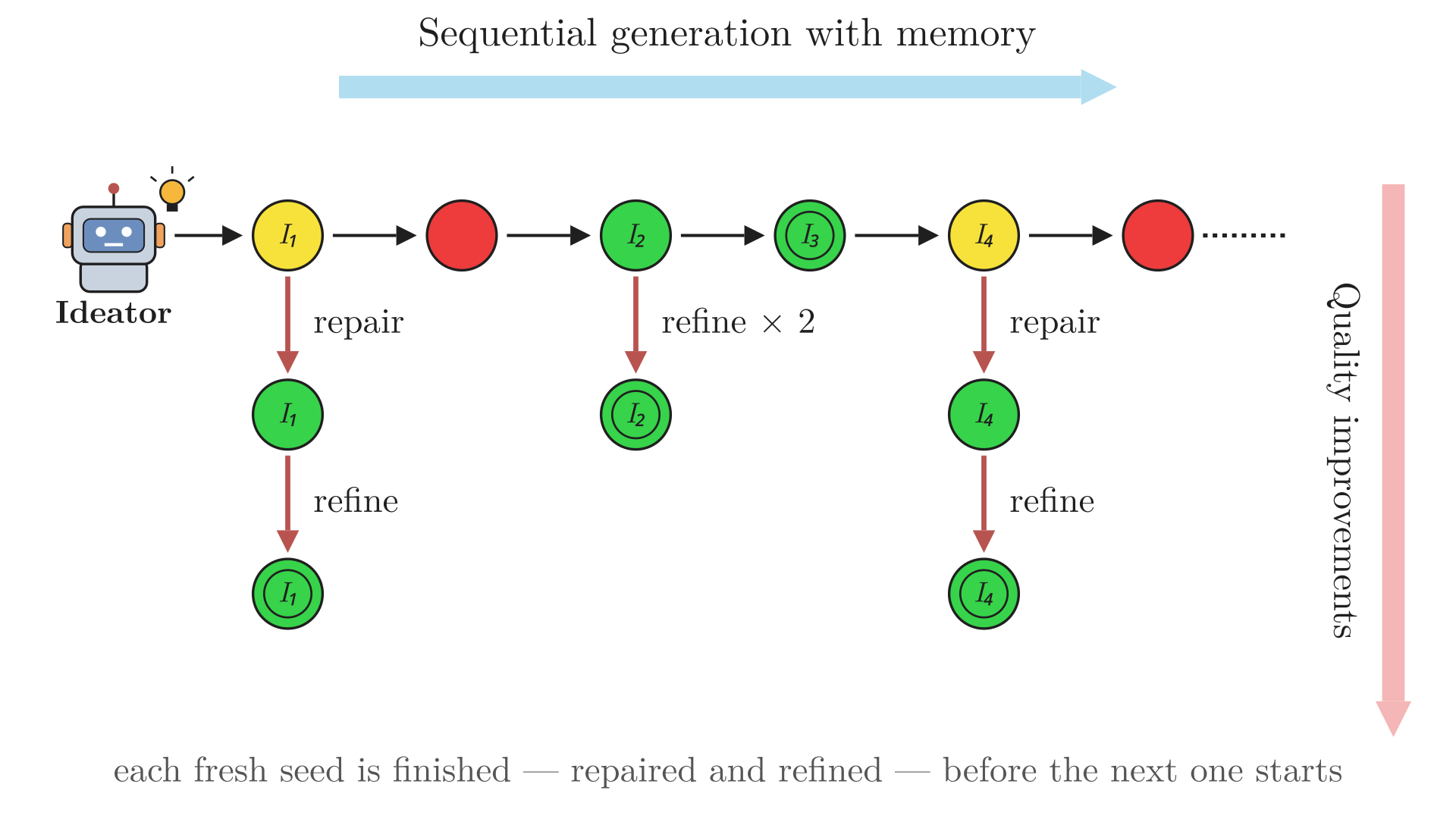
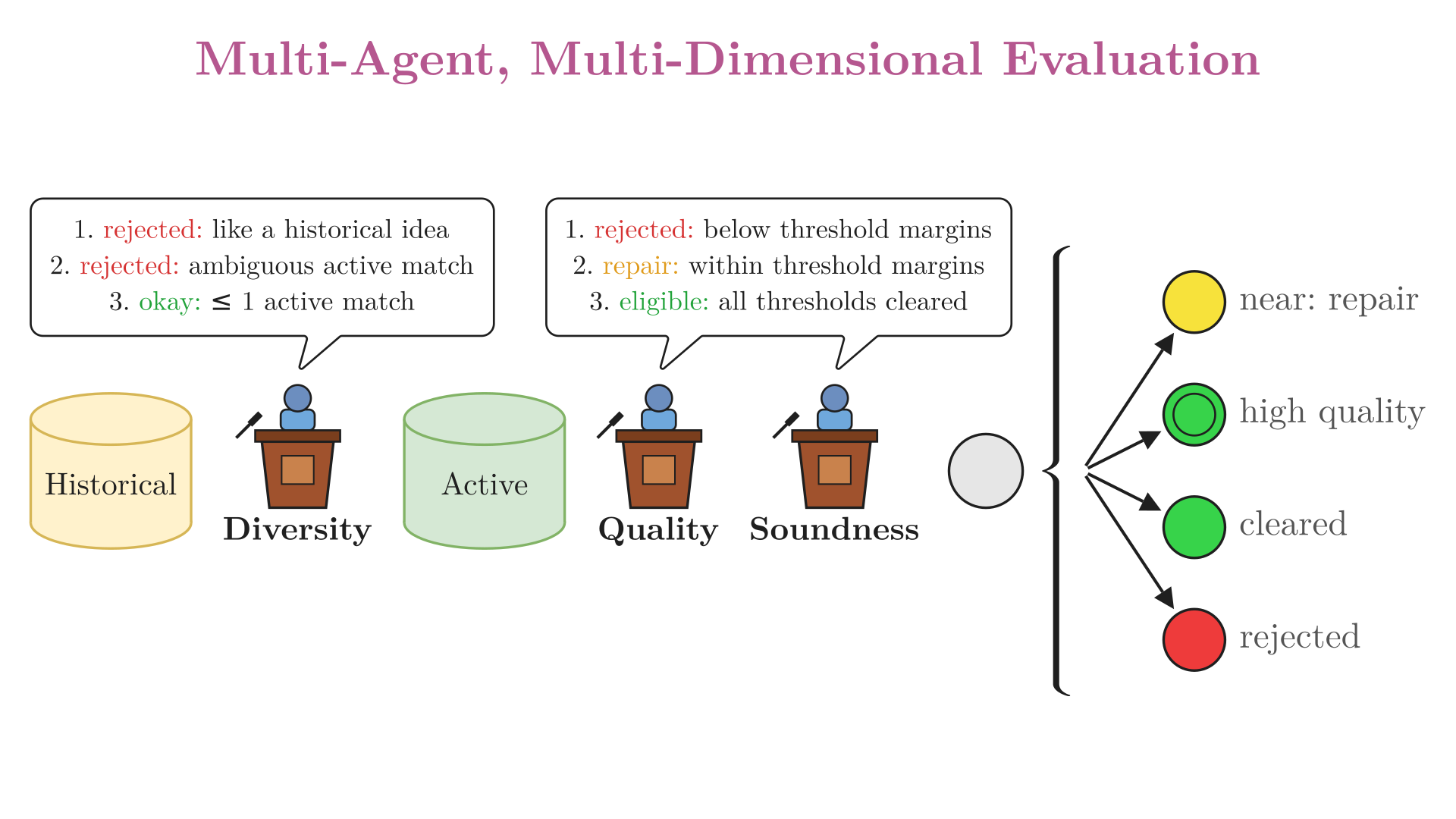
tracks idea evolution through lineages. We jointly drive Quality using multi-objective feedback for
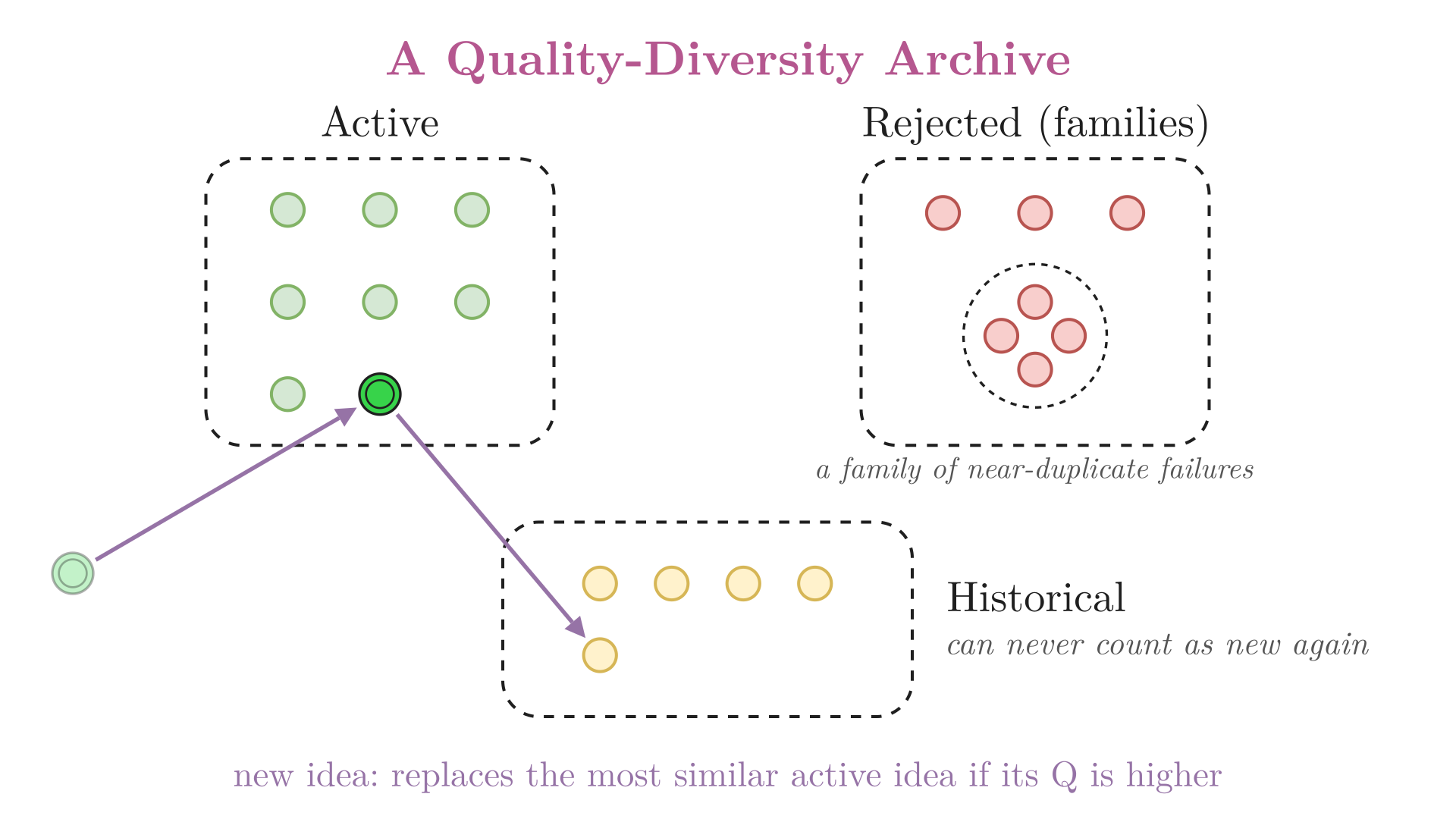
repair and refinement, while Diversity is achieved through lightweight sequential memory and explicit
comparison against completed ideas, historical variants, and rejected proposals. To evaluate this joint objective, we
develop Yield, a metric that computes the largest mutually diverse set of ideas satisfying predefined quality
thresholds. Across 32 topics spanning 8 CS domains, IDEAgent outperforms the best baseline by 3.89× on Yield,
while achieving Yield of at least 2 on 8× as many topics. We further analyze quality improvements, showing that
repair and refinement improve logical rigor and clarity while preserving non-obviousness. Lastly, we extend IDEAgent
to two algorithm discovery tasks for verifiable quality judgment and find that it still consistently outperforms all
baselines, and yields the largest set of high-quality and diverse programs that beat a trivial/standard baseline.
To encourage future research on QD-search-based ideation, we open-source IDEAgent at
https://github.com/declare-lab/IDEAgent.
Method at a Glance
From Ideas to Verifiable Programs
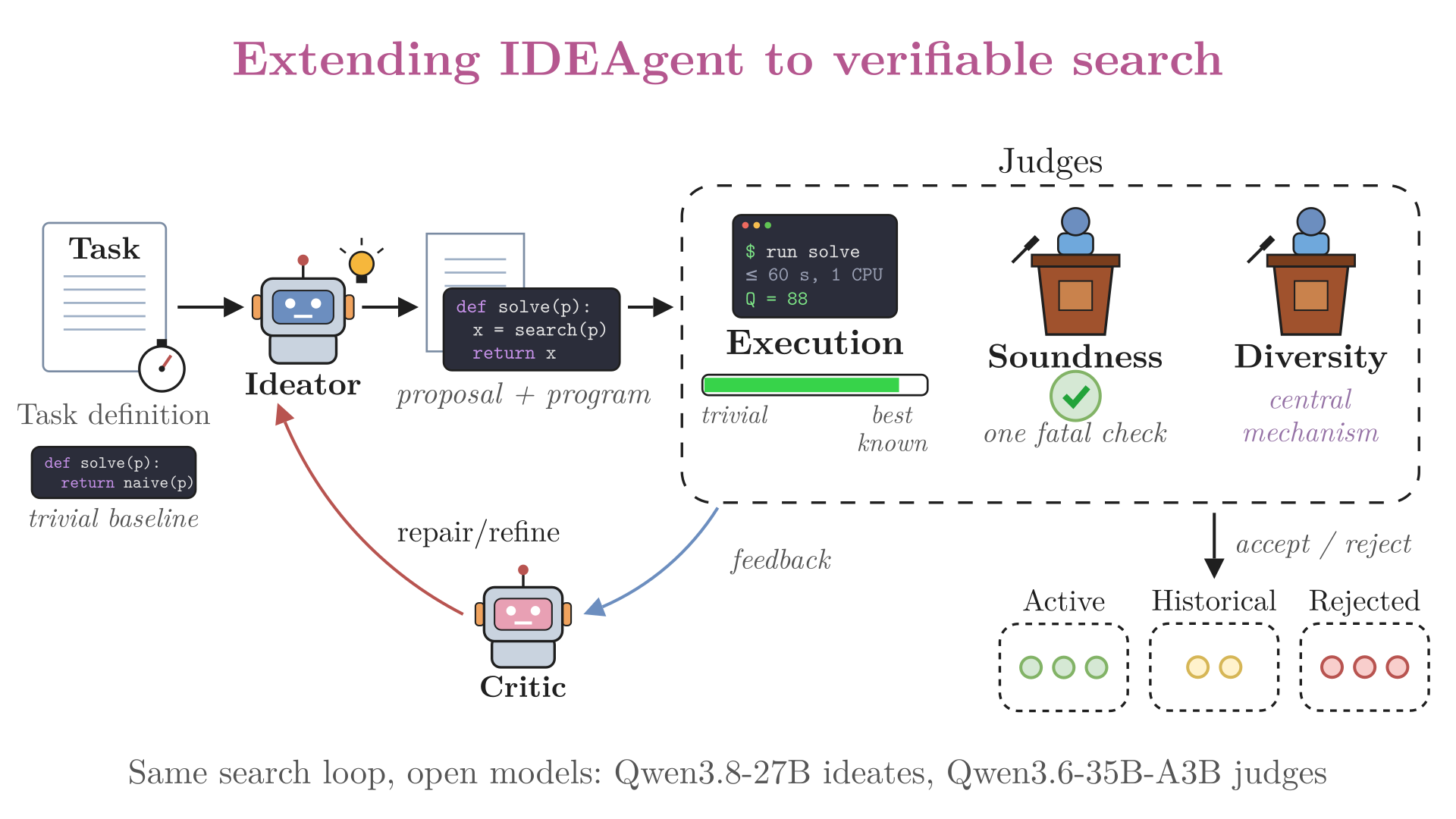
- Background papers → the task definition and its runtime limits, plus a trivial baseline that every idea must beat.
- An idea → a proposal together with the Python / C++ program that implements it.
- Non-obviousness and clarity judges → removed. Quality is measured: the program runs in a sandbox (60 s during search on AlphaResearch, the contest time limit on ALE-Bench), and Qi is its normalized progress from the trivial solution (0) to the best-known result (100).
- Soundness panel → one fatal check: the program implements the proposal, with no shortcuts or hard-coded answers.
- Diversity judge, archive and critic → unchanged; distinctness now lies in the central mechanism. A valid idea that does not beat the baseline gets one repair; one that does gets up to two refinements, and a higher-Q child replaces its parent.
- Models → open models: Qwen3.8-27B as the Ideator; Qwen3.6-35B-A3B as the critic, soundness and diversity judges.
Results: Research Ideation (32 topics)
| Method | Yield (NB≥7) | Yield (NB≥6) | Topics with ≥1 qualifying idea (NB≥7) | Topics with ≥1 qualifying idea (NB≥6) |
|---|---|---|---|---|
| Single-shot | 0.000 | 0.000 | 0 / 32 | 0 / 32 |
| Sequential-Memory | 0.188 | 0.531 | 6 / 32 | 14 / 32 |
| Stateless | 0.250 | 0.812 | 7 / 32 | 24 / 32 |
| NOVA | 0.281 | 1.156 | 8 / 32 | 25 / 32 |
| IDEAgent | 1.094 | 2.312 | 27 / 32 | 31 / 32 |
Jury average of two external judges; Yield at D≥7, S≥7, C≥6 with the stated non-obviousness (NB) threshold.
Results: Verifiable Algorithm Discovery
AlphaResearch (Python; Q = 100 is the human best)
| Method | Qmax | Qavg | Y0 | Y50 | Y75 | Y100 |
|---|---|---|---|---|---|---|
| Single-shot | 53.2 | 16.9 | 2.78 | 1.00 | 0.44 | 0.33 |
| Sequential-Memory | 92.6 | 46.1 | 4.00 | 3.11 | 1.67 | 0.56 |
| Stateless | 93.5 | 47.8 | 4.11 | 3.11 | 1.78 | 0.56 |
| NOVA | 75.4 | 34.4 | 4.56 | 2.67 | 0.78 | 0.22 |
| IDEAgent | 106.2 | 54.5 | 5.67 | 4.44 | 3.11 | 0.67 |
ALE-Bench (C++ heuristic contests; Q = 100 is the contest winner)
| Method | Qmax | Qavg | Y0 | Y25 | Y50 | Y75 |
|---|---|---|---|---|---|---|
| Single-shot | 14.8 | 6.2 | 1.14 | 0.43 | 0.43 | 0.00 |
| Sequential-Memory | 38.3 | 18.6 | 2.29 | 1.71 | 1.14 | 0.29 |
| Stateless | 45.1 | 22.7 | 2.29 | 1.71 | 0.57 | 0.00 |
| NOVA | 37.3 | 18.0 | 2.29 | 2.00 | 1.00 | 0.00 |
| IDEAgent | 56.4 | 22.6 | 3.43 | 2.57 | 1.57 | 0.57 |
Yk: size of the largest set of mutually distinct ideas among those that clear the trivial solution with progress Qi ≥ k (Y0 counts every idea that clears it). Qmax and Qavg: the highest and mean Qi among a problem's ten final ideas. All averaged over a benchmark's problems; a pair is distinct when a majority of three judges (Gemma 4 31B, MiniMax-M2.7, GLM-4.5-Air) say so. Bold marks the best value in each column.
BibTeX
@misc{gumma2026ideagentagenticqualitydiversitysearch,
      title={IDEAgent: Agentic Quality-Diversity Search for Research Idea Generation},
      author={Varun Gumma and Navonil Majumder and Soumitra Sinhahajari and Soujanya Poria},
      year={2026},
      eprint={2607.22375},
      archivePrefix={arXiv},
      primaryClass={cs.AI},
      url={https://arxiv.org/abs/2607.22375},
}